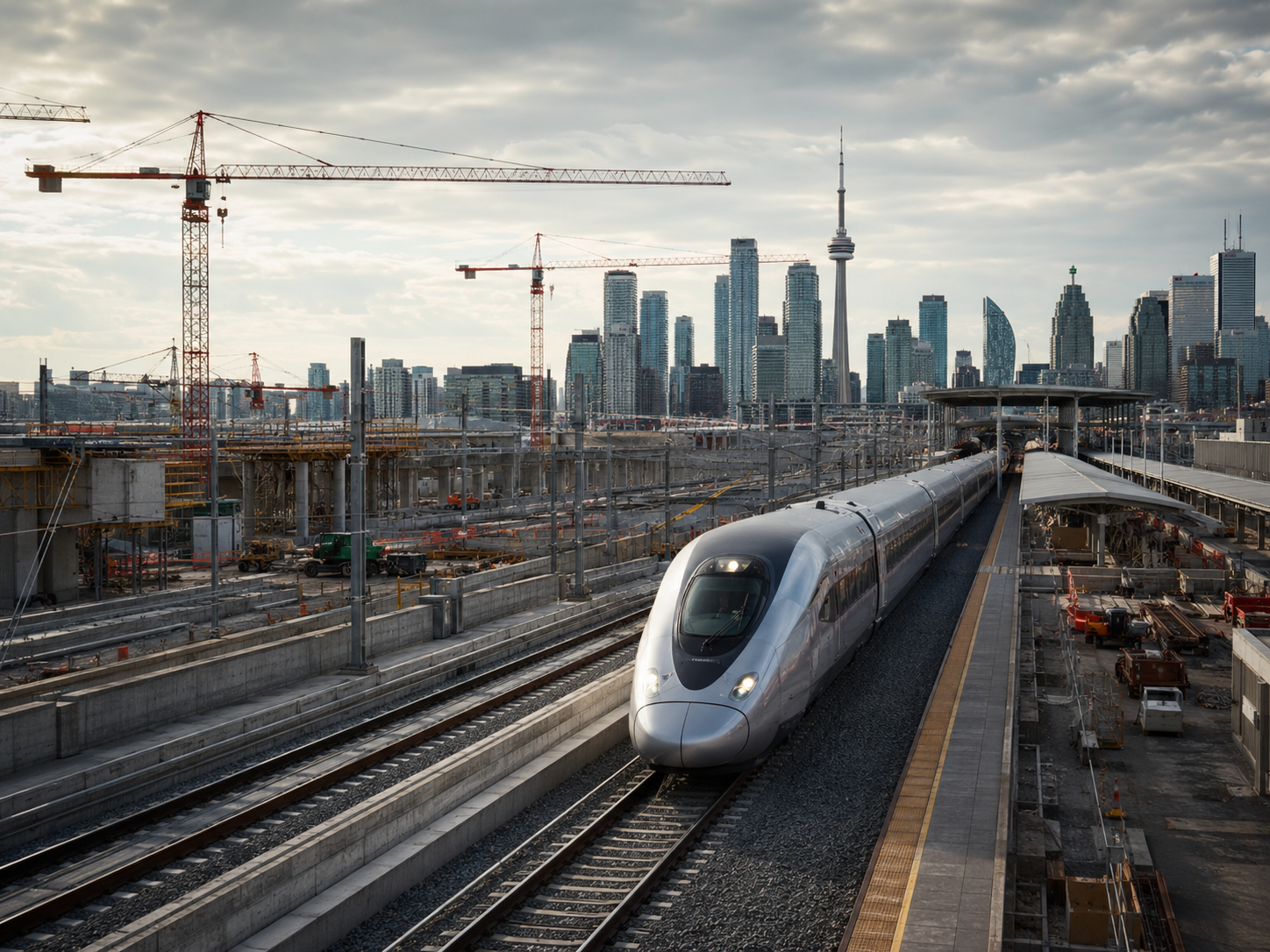
In February 2025, with his resignation already announced and a Liberal leadership race underway, Prime Minister Justin Trudeau stood in Montreal and declared that Canada would finally build a high-speed rail network. The project, branded Alto, would connect Quebec City and Toronto at speeds of up to 300 kilometres per hour. Montreal to Toronto in three hours.
It was, by every measure, the largest infrastructure announcement in Canadian history.
It was also, by some measures, the most convenient timing in Canadian political history.
Trudeau had floated high-speed rail in three successive election campaigns. Three mandates of studying, consulting, and committing to future studies. What changed in February 2025 was not the feasibility of the project. It was the political calendar. An election was weeks away. A new Liberal leader would be selected by March 9. Trudeau's window to shape legacy was closing fast.
The federal government committed $3.9 billion over six years for what it called a co-development phase, the stage at which the project's route, station locations, and construction specifications would be finalized. No track would be laid. No trains would be ordered. The actual construction cost, according to Transport Canada's own estimates, could reach $80 billion.
The private consortium selected to co-develop the project, named Cadence, includes some names that have drawn scrutiny. AtkinsRéalis, formerly SNC-Lavalin, brings a record that includes legal settlements tied to corruption charges and criticism over its role in Ottawa's troubled O-Train Line 1 expansion. Air Canada sits at the table as well, a carrier whose commercial interest in limiting rail competition raises questions about its role in designing the very network that would compete with its routes. CDPQ Infra, the infrastructure arm of the Caisse de dépôt, rounds out the group. It is a credible infrastructure builder, though one whose REM decisions in Montreal have drawn criticism for routing choices that will now require Alto to construct an additional tunnel just to reach Central Station.
Trudeau acknowledged at the press conference that a future government could modify or cancel the project. He expressed confidence it would proceed regardless.
That confidence has not been tested yet. The Carney government inherited Alto, and as of mid-2025, the co-development phase is nominally underway. But with construction not expected to begin until the design phase concludes, a window of four to five years, and with a total price tag that has never been formally acknowledged, the project exists in a familiar Canadian infrastructure state: funded for planning, uncertain on delivery.
For the construction industry, Alto represents something real and something speculative simultaneously. Real in that $3.9 billion in professional services, engineering, and planning work will flow in the near term. Speculative in that the workforce required to build 1,000 kilometres of new dedicated rail corridor does not currently exist in Canada and would need to be assembled at precisely the moment when housing, hospitals, and energy infrastructure are all competing for the same tradespeople.
The question the industry should be asking is not whether Canada needs high-speed rail. It clearly does. Canada is the only G7 country without it. The question is whether the country has the labour, the coordination capacity, and the political continuity to build it. Or whether Alto joins a long list of nation-building infrastructure announcements that live in design phases indefinitely.
The train was launched. Whether it ever leaves the station is a different matter.