
Capstone Insights Q4 2026
The MEP Interface Gap: What to Define Before Procurement and Handover
By Dennis Chiang | Independent Contributor
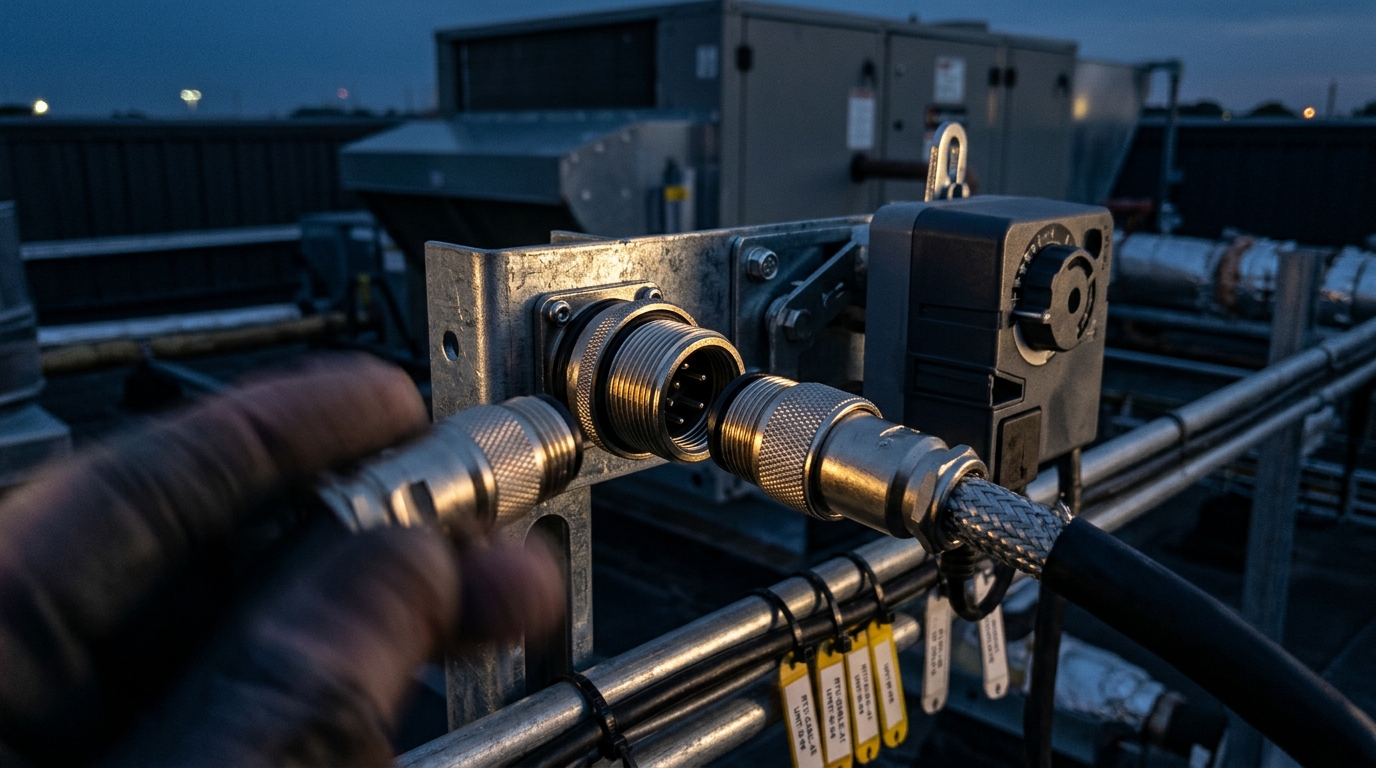
Why replaceable electrical and control connections need an owner before the project reaches commissioning
Several years after handover, a facilities technician is replacing an actuator at a rooftop unit. The device tag is legible and the replacement unit is available, but the O&M manual identifies the actuator without recording the cable assembly, pin assignment or mating interface. Before the new device can be connected, the technician has to reconstruct information that could have been captured during the project.
The issue is narrow but practical: when an interface is expected to be disconnected or replaced during the life of the equipment, the project should define what it is, who supplies each side and how that information will survive handover.
This article deals mainly with control and signal circuits used for sensors, actuators, BAS points and selected communications. Here, "low-voltage" is used only as project shorthand for those circuits, not as a code classification. The applicable electrical code governs how a particular circuit is classified and wired. Line-voltage and branch-circuit connections remain outside this article's scope and must follow the applicable electrical code, equipment approval or certification requirements, manufacturer instructions and project specifications.
Where the interface can lose its owner
On many projects, responsibility is divided across several packages. In one common arrangement, the consultant defines the control function, the equipment OEM supplies a device or packaged unit, the BAS contractor completes controls wiring and the electrical contractor provides power infrastructure. Commissioning confirms operation; the owner inherits the system for service.
A field interface can appear on several documents without being fully defined on any one of them.
Permanent building wiring, OEM internal wiring, replaceable field connections, controls interfaces and communication links are different categories. A permanent termination may suit a connection that is rarely disturbed. A detachable interface can be useful where a sensor, actuator or modular assembly is expected to be removed. For communications, physical mating is only one check; protocol, shielding and pin assignment can matter just as much.
Put the decision into the project workflow
The following is a recommended project practice rather than a Canada-wide code requirement.
During design, the consultant or controls designer can identify which field connections are expected to be opened for replacement or maintenance and define circuit function, voltage and current, signal type, shielding, environment and the consequence of incorrect mating.
During equipment and controls submittal review, the OEM and installing contractor can turn that requirement into a defined assembly. The shop drawing should identify the interface, mating counterpart, pin assignment where relevant, cable construction and who supplies each side. It should also distinguish an OEM-supplied lead from a cable that will be terminated in the field.
At commissioning, the installed connection can be checked against the accepted submittal, with equipment labels, drawings and the O&M record brought into agreement before closeout. That gives the interface a clear owner without creating a new process for every cable on the project.
Define the circuit before choosing hardware
A BAS temperature sensor, damper actuator and communication trunk may all be described casually as low-voltage work, but they do not have the same electrical or data requirements. For each replaceable interface, establish the actual voltage and current, conductor requirements, signal characteristics and shielding.
Location changes the material question. A connection above a ceiling in conditioned space faces a different duty from one at a rooftop unit, in a damp mechanical room or in a parkade exposed to moisture and contaminants. Where visually similar connections sit beside each other, coding, keying, labelling or another means of differentiation should be considered.
Before a replacement device or cable is energized, it should be checked against the interface record and the manufacturer's data because mechanical fit does not establish electrical compatibility.
Keep the Canadian regulatory boundary clear
The 2025 edition of the National Building Code of Canada is published as a National Model Code. Provincial and territorial governments adopt or adapt the National Model Construction Codes into regulation, and the NRC directs users to the appropriate jurisdiction to determine what applies.
In many jurisdictions, building-code and electrical-safety requirements are administered through related but distinct regulatory frameworks, although the two can cross-reference each other. CSA C22.1:24 is the 2024 Canadian Electrical Code, Part I, 26th edition. CSA states that Canadian authorities having jurisdiction reference the CEC, while each jurisdiction determines which edition is referenced in its regulations.
A component data sheet is therefore not an installation approval. Local amendments, AHJ decisions and applicable equipment approval or certification requirements still have to be satisfied for the final installation.
An IP rating answers a narrower question
IEC 60529 covers the classification of degrees of protection provided by enclosures under the IP Code. An IP rating should not be treated as proof of chemical resistance, UV durability, corrosion performance or cable flex life.
For a detachable connector assembly, the project should confirm the configuration in which the manufacturer claims the IP performance, including whether correct assembly and full mating are required. That becomes relevant during service, when caps, seals or mating parts may be removed.
Cable construction belongs in the same review. Conductor size, shielding, jacket material, strain relief, support and routing should be checked at shop-drawing stage rather than left to whoever terminates the cable on site.
Prefabrication makes the boundary more visible
Mechanical skids and factory-assembled controls create a literal shop-to-site connection point. A cable may be disconnected for transport and reconnected in the field. If two adjacent receptacles look alike, a site crew can restore the mechanical connection without necessarily restoring the intended electrical one.
The shop drawing and equipment identification should make the intended mating relationship clear before the assembly leaves the factory and still be clear after transport, installation and commissioning.
Handover should preserve what was accepted
As recommended project practice, an owner or consultant can require selected replaceable interfaces to appear in the as-built and O&M information. An interface schedule can record equipment and location, function, mating counterpart, pin assignment, cable specification, electrical or signal information, shielding requirements and the reference used for replacement.
If the schedule includes an "approved replacement," the basis should be clear: for example, an OEM reference, an accepted project standard or another designated approval authority. Where continuity of service justifies it, the owner can also decide whether spare mating cables or counterpart assemblies belong in the turnover package.
Before final closeout, commissioning should confirm that the record matches the installed equipment. Years later, a technician should be able to identify the intended connection and verify a replacement without having to reconstruct the project team's original decision.